Renovating Houghton with Steven Hillyer
TBD
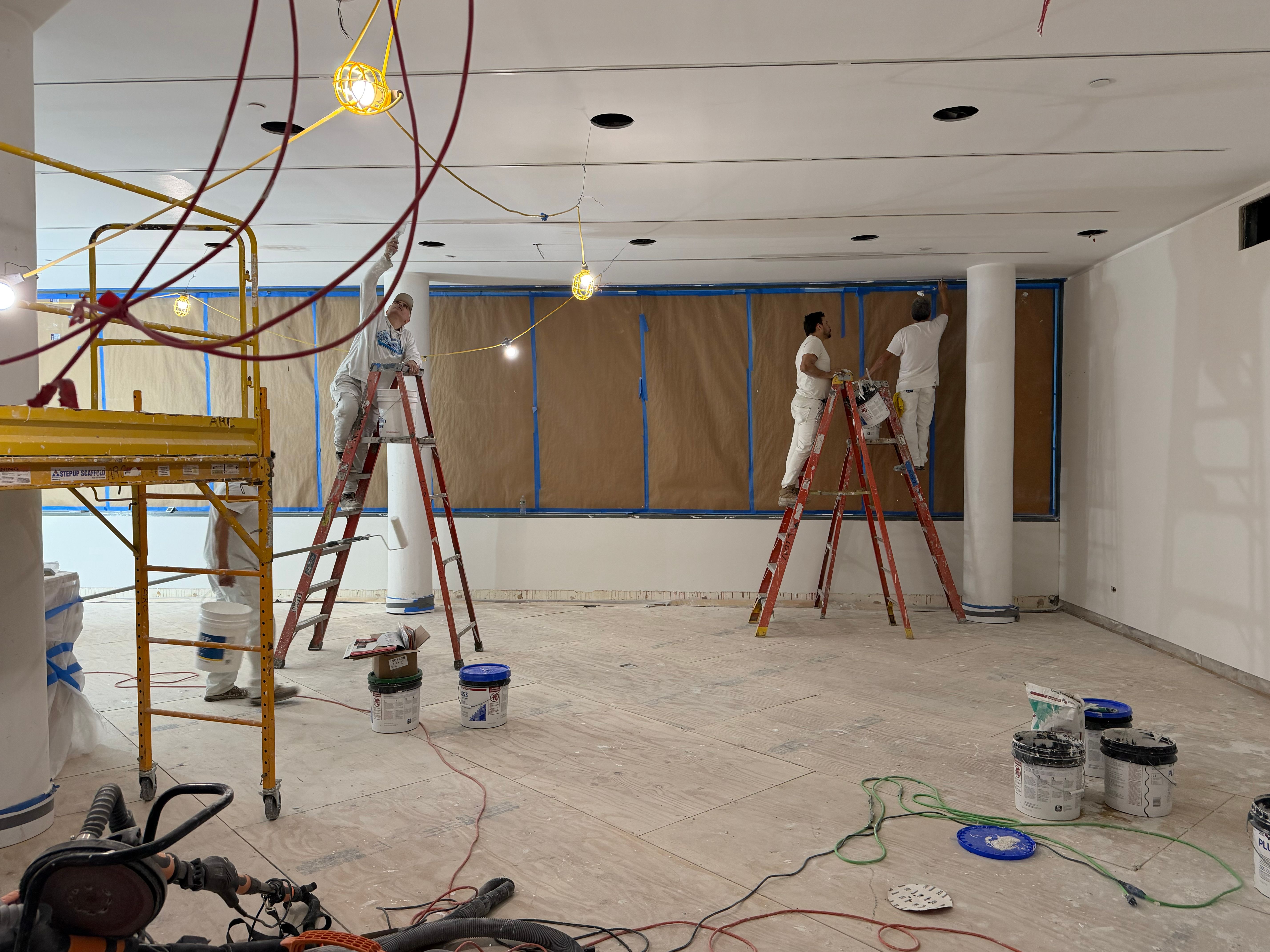
The renovation of the Arthur A. Houghton Jr. Gallery on the second floor of the Foundation Building is complete after nearly a year of planning and construction. Steven Hillyer, the Architecture Archive’s director, envisioned and oversaw the project, designed by longtime faculty member and Cooper alumni Sam Anderson of Samuel Anderson Architects. On April 16, the renovation opened to much fanfare with a retrospective of the late Alexandra Kiss, an architect and artist who graduated from The Irwin S. Chanin School of Architecture in 2005.
Ilea Wunder
Steven Hillyer
How did the renovation come about?
We've known for a long time that the gallery was getting run down. It’s been fifty-two years since the interior renovation. Although there were modest renovations over the years, I think the last one was in the 1990s when they replaced the walls because they were so heavily used. It was really taking a beating, and without temperature and humidity control, things sag and fall off the walls when it’s rainy and humid.
The Cooper Union’s annual budget has a capital expenditures program. We were able to do this because it is a rotating budget and it was architecture's turn.
And then the architecture school decided this was the thing.
Yes, I had been speaking with Natalie Brooks about this for some time. Trying to become museum quality in this one-hundred-sixty-something year-old building is a challenge and this was the way that we could finally do it. There’s also an intention to make the library archives temperature and humidity controlled. And when they do that, because we’re directly above them, the same thing will happen for the archive. So, I learned a lot about what it takes to get to that point. A number of times over the years we tried to borrow works for exhibitions, and we couldn’t because we didn’t have museum-quality standards. In 2001 we mounted the exhibition Wall House 2: John Hejduk and I approached The Museum of Modern Art for two drawings they had in their collection, and they said no. The interesting thing about it was that those drawings, before they were acquired by the museum, used to live in the library archive space just below us, because that’s where John kept all of his work. So it was kind of hilarious to me that they couldn’t come back to where they had been.
Yes. Do you remember when it was officially decided that the renovation would take place?
It was sometime in early 2025, I believe.
Can you talk about the process of choosing the architect who would lead the renovation?
Yes. A request for proposals was put forth by the facilities office and Cooper Union's owner's rep—I think we received five or six proposals. Each architect was then invited to make a presentation, and those presentations were winnowed down to two, and Sam Anderson was one of them. Sam Anderson Architects was chosen. They’ve done restoration work in the Peter Cooper Suite in the 2000s, a light upgrading in The Great Hall, and they designed the AACE Lab on the fourth floor.
It's John Hejduk's interior; that's a huge deal. But time marches on, and you need to do things in buildings. And some of the work that's been done in this building hasn't been so great, but Sam has been respectful to Hejduk’s interior renovation. I advocated for him because I think it's better to have one architect making several upgrades and interventions than having ten architects making wildly different ones. It just feels like it's more cohesive.
Yes. And him being a Cooper grad makes it feel all the more ... happy. And in the right hands.
Yes, and I don't know if you know this, but there are three people working on this from his office—Sam himself and then Eddie Gormley. Eddie was my Cooper Union classmate. We've known each other forever. And then the third person working on this is Danny Smith, also a Cooper grad. So, it's nice that it's all in the family.
Could you talk about how the process has been so far? Renovating while still operating the archive?
The trick of this project is that they had to replace two separate air handlers and then reconfigure all the ductwork in the hallways and into the gallery itself. Also, to have temperature and humidity control, you need a chiller and a heat pump, both of which had to go up on the roof. The heat pump required hydronic piping, which runs through a shaftway in one of the bathrooms from the second to the seventh floor. It was a Herculean effort, and we were lucky to have Jeff Nash, an incredible lighting designer help.
Buildings can be unpredictable and unruly. I'm sure it's a relief to have this closed loop independence, especially even just in the past few weeks with flooding, fires…
They can be very unpredictable and unruly. In the summer, when we're not in the building, they don't have the air conditioner as cool. In the winter, probably the same thing—not as warm. Now that's no longer going to affect the gallery. The gallery will be its own quiet little loop minding its own business.
I know you're planning a soft launch of the gallery this April.
Yes, with an exhibition featuring the work of Alexandra Kiss, a 2005 Cooper architecture grad. Alex was an incredibly talented artist when she came to Cooper Union, and she was mentored by Sue Gussow, who included her in Architects Draw, her 2008 book. In 2018, Kiss shifted her focus from architecture to her art. Her work looks at growth through drawings of tree bark, and also decay, through decayed leaves that she found in her walks through the forest. She spent a lot of time walking in the forest. And there's a small group of drawings of “nurse logs,” which are fallen, decaying logs that feed the forest. She also made drawings of her daughter, Sophie. It's all incredibly, incredibly beautiful work. Alex passed away in September of last year, so we wanted to honor her and her work. I have a personal attachment to all of this because Alex was a friend. I just really want to honor her and celebrate her work.
What other things would you say the archive and the gallery is excited for with this humidity and temperature control? If there are any others.
I think it just opens up a ton of possibilities for us that we wouldn't have been able to consider before. As an example, we're putting together a retrospective of Raimund Abraham's work that’s coming to us from Germany in the fall. I think the earliest project in the exhibition dates to 1955. The curator of the show came to New York and we met; it sounded really exciting and he sent me imagery and it was really amazing stuff. And then I got an email from Martino Stierli from MoMA, who was encouraging Cooper Union to take this exhibition because it was so important—and since Raimund taught here, it was the perfect venue. It was nice to get that kind of outreach saying this could be important for you to do. And there's a few other exhibitions that I'm conjuring further down the line: one from the collection of the New York Botanical Garden, and another from the Roberto Burle Marx Archive in Brazil. And those are things that I would not have been able to ponder previously at all.