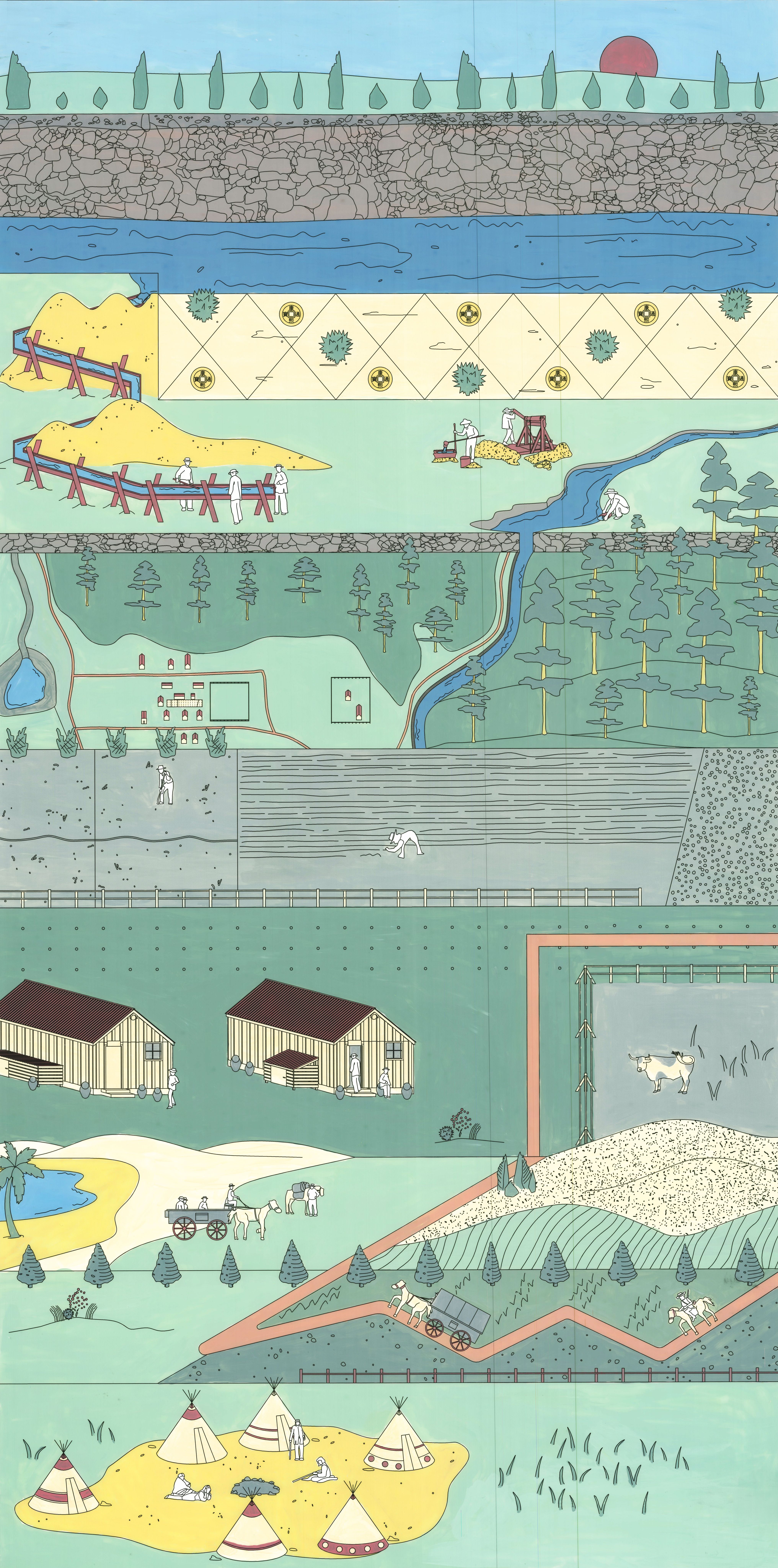
Civic Wilderness: Blackfoot City
TBD
This thesis sits within the discourse of wilderness. What is imagined in the American West—vastness or place? The answer shifts depending on position: local or passer-through.
In Montana, vastness is encountered as an operative condition. Landscape is structured by repetition and distance, and organized through linear thresholds—FENCE, COW, MOUNTAIN. Lives are present but dispersed, read from the car as a serial field of perception punctuated by limited architectural reference.
Against this condition, a civic hall is proposed not as a singular object but as a distributed system of components. Rooms that hold time differently: indexing the past, occupying the present, and making space for the future. Framing becomes the primary architectural act—an instrument for arresting, isolating, and re-situating fragments of landscape and history.
Blackfoot Cemetery operates as an archive of the now abandoned Blackfoot City, holding both the buried and the unburied. The field of the former city becomes a civic ground where a post office, meeting halls, and the archive of Blackfoot City's Chinatown are reconstituted as public infrastructure. Along Ophir Creek, a rock wall is extended into a site of intellectual accumulation: a library embedded within a condition of continuous influx, set against a retaining structure that holds both material and unspoken histories.
Vastness is no longer treated as emptiness. It is read as a constructed surface—made legible through repetition and made active through acts of framing.