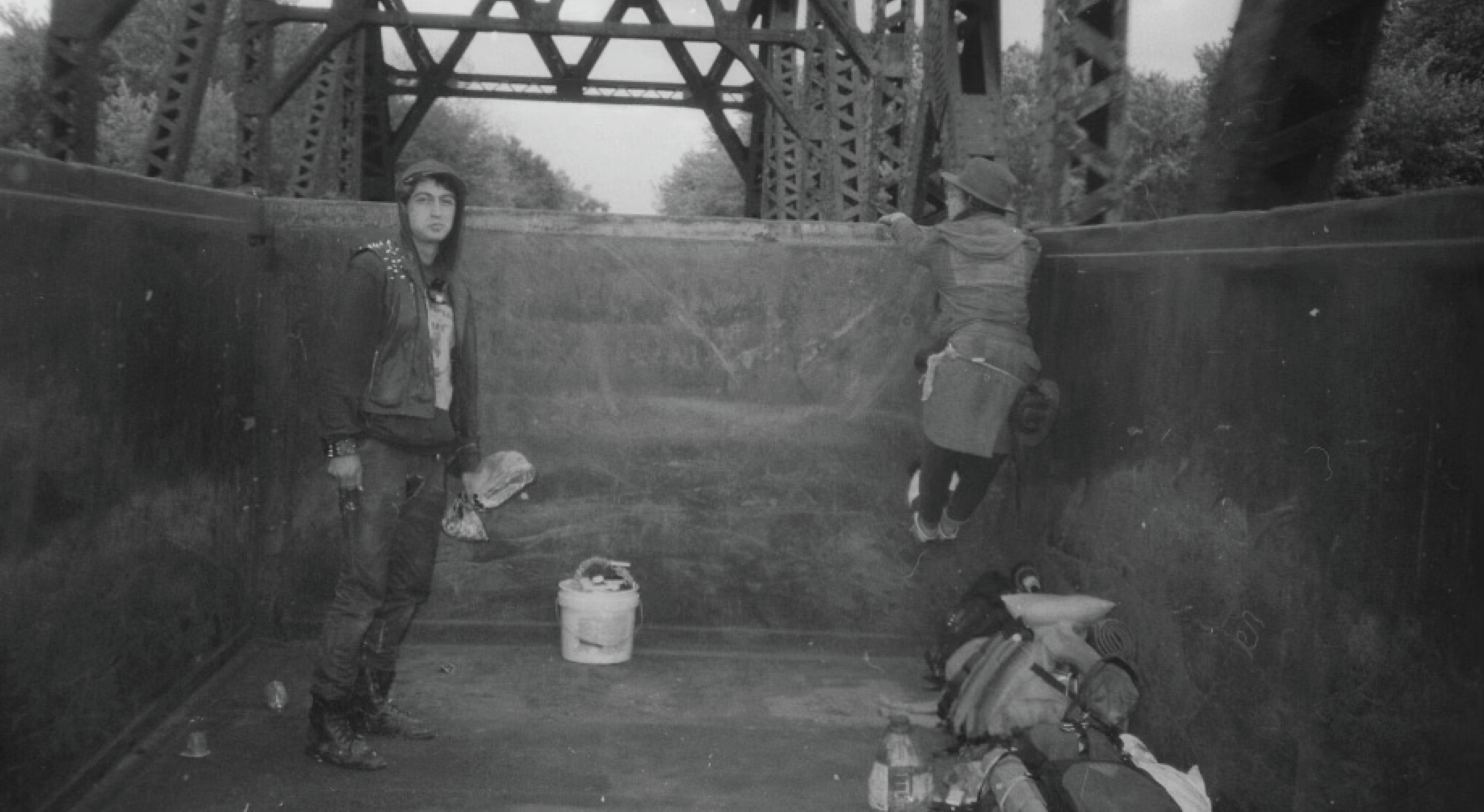
Agoraphobic Train Hopping
The following interview is with my friend Switch. Switch and I met working at a bike shop together in Bushwick this past summer. Switch would always have an incredible story to share from her own life, or an insightful opinion or reference to the conversation at hand. Switch is one of those people that I always run into by happenstance. We’ll end up spending an afternoon or an evening hanging out in a park or just riding our bikes around. Admittedly, in trying to plan this interview, we both had a fair amount of trouble formally scheduling time to talk. As the deadline crept closer, by a stroke of luck I ran into her while riding my bike through Chinatown—she was there dropping her phone off to be repaired. We went to a local dumpling spot and sat in the window for two hours and talked. I recorded the conversation; this text is an abridged version.
Abe Switch
S: When I was a kid, I dealt with agoraphobia. It’s the fear of not being able to get to a safe space—being stuck somewhere and unable to return somewhere safe. I was a scared child with an overactive imagination. I was scared of
everything.
Fast forward to young adulthood—I was comfortable being alone in the middle of nowhere in Utah, under a bridge, far from anyone, waiting for a train that may or may not come. It’s exactly the setting where something bad would happen in a scary movie. At some point I realized there are things that go bump in the night, and it’s me. When someone hears a person in a remote place, it’s probably me or someone like me, just trying to get from point A to point B, or passing through and needing a place to sleep.
I guess my brain does me a solid. The situations that would be the scariest are the ones I don’t get afraid of.
This was when you were train hopping?
Oh yeah. I’ve been to all the lower forty-eight on trains.
All the lower forty-eight on trains. Damn. When did you start?
I rode my first train in 2014. I was twenty.
Sometimes the places you get on a train are the most bizarre middle-of nowhere spots. Sometimes it’s a dense urban center. There are IM facilities in cornfields where everyone commutes an hour or two because there’s nothing around—like North Baltimore, Ohio. If you get dropped there, the only thing you can do is get on another train. You’re not walking through corn to civilization.
What’s IM?
IM stands for intermodal, it means trains that carry shipping containers. The containers travel by many modes of transportation, big freight liner boats, trains, trucks...
For riding, IM trains tend to be the fastest, highest priority trains, so if you’re trying to go a long distance and don’t want to deal with having to get off, or to switch trains, or worrying about staying on when they block swap, or do other work, then riding IM is a good idea. Drawbacks are less choice of rides, you’re more visible than on most kinds of grainers—Cadillacs, high walls, alien eyes, shotguns, Canadian grainers. Boxcars are as comfortable as it gets.
How do you pack for a trip like that?
No tent. Sleeping bag. A bivy sack is good but not necessary. Three days of food and water, ideally. One change of clothes. A rail map.
What’s the longest trip you’ve been on?
My life was circling the country. I measured years in laps. I had an abandoned shipping container I lived in. I stole solar panels from payphones and set it up. It’s still there, but not like it used to be. It got arsoned.
It used to look like a rusty container on an abandoned train bridge with weeds up to here. But inside it was framed and drywalled. It was crazy cool.
Before train hopping. I was born in Brooklyn, left as a kid, came back around 2014 or 2015. Boston was my home base, then back to New York.
Every year I’d come back to New York in the fall, work as a bike messenger—December was crazy busy, that’s when I made money. Then I’d go to New Orleans for New Year’s. Sometimes I’d come back and work through February. By March I was out, traveling until fall. It didn’t feel like a trip. It was just my life.
The longest I ever spent on one train was ninety-seven hours.
Ninety-seven?!
On one train. From Birmingham, Alabama to Needles, California.
There’s no single railroad that crosses the country, but there’s one train that effectively does. Chicago is the rail hub. If you time it right, you can ride through the handoff.
The train I took starts in Atlanta, goes to Birmingham, then up to Memphis, Springfield, Missouri, up a bit more, then down through Oklahoma, into Texas, meets another line, goes through New Mexico, and ends in Needles, California —right near the Arizona border.
Being from the city, when people talk about feeling at peace in nature, I don’t. I’ve been in remote places—trains can take you places there’s no other way to reach. That’s scary.
There’s a crew change in Ruby Canyon on the Denver and Rio Grande Western.
It’s famous for going up and over the Rockies, which is a huge engineering feat because trains don’t like hills. A 9 percent grade is insane. Getting a train 11,000 feet above sea level is wild.
Usually trains tunnel through mountains, but the Rio Grande goes up and over. Ruby Canyon is the kind of place where if you step off the train, you’d immediately get eaten by a mountain lion. It’s nowhere.
When I’m on trains in wilderness like that, it’s scary because I’m relying on this big hunk of metal to get me out.
And if you get caught, they’ll just kick you off and you’ll be stranded?
Most of the time if you get caught, they either write you a ticket or call the cops and send you to jail. In a place like that, you probably wouldn’t get caught.
If they did spot you in the middle of nowhere, they’d radio ahead to the bull—that’s a railroad cop. They’re federal officers who work for the railroad.
In the old days, they were brutal. Train riding is old. There were railroad goons whose job was to beat people up. That’s where “bulls” came from.
These days it’s usually just a ticket or jail. When I started riding, there were rumors about certain towns—like Officer Flood in Roseville, California—who hated train riders.
Because I’ve never driven, when I go camping somewhere remote, I don’t feel peaceful. I feel dependent on a vehicle I don’t know how to operate and whoever brought me there.
If I woke up and everyone had left, I’d be stranded. I’d feel that same agoraphobic panic—how do I get back to civilization?
My friend Sid spent most of the last decade in London squatting. He ended up in rehab upstate somewhere where, if you don’t have a car, you can’t survive. You’re not walking ten miles to the grocery store in the snow. He said he got there and immediately felt like he’d made a mistake—that agoraphobic feeling.
There’s so much of America where, if you don’t have a car, it’s frightening. You need the car to get to safety.
That’s why I like New York.
You told me about that tower where you slept on the roof. I feel like you couldn’t do that in the same way somewhere else.
No way. That was awesome. It’s in Midtown.
There are delis that look normal from the outside. Beers are a little more expensive, and there’s a discreet staircase.
You go upstairs and there’s a huge empty room, maybe two tables with people drinking. It’s basically a bar but not legally a bar. A lot of Guatemalan construction workers hang out there. Some might even sleep there. I’d see the same guys constantly and realized they might be homeless get off work, drink, pass out, wake up, go back to work.
One of those spots was connected through a stairwell to a skyscraper around the corner. We realized the building wasn’t just three floors. We kept going up and ended up in a different building. We said, let’s see how high it goes. It went up forty-one floors.
You took the stairs?
Yeah.
And you took the elevator down after sleeping there?
In the morning. It was summer, so no sleeping bags. We shared a jacket. We started noticing businessmen doing double takes, so we decided to leave. We just pretended to be messengers and took the elevator down.
The funniest thing was looking at all the glass condo towers. So many of the rich people had telescopes. None were pointed at the sky. They were all pointed into other apartments. Everyone was watching each other.
Is that a thing? Rich people having telescopes?
It must be. There were too many for it to be coincidence.
That’s crazy.
They choose to live in those glass-wall buildings. If I were rich, I’d want privacy. I don’t understand wanting your whole life on display. Maybe they get off on it. But the only people who can see those rich people are other rich people.
They can look down on everyone else, but only other rich people can look back —unless someone sneaks up to a taller building.
Like you on the roof.
It’s funny how my life went from being an agoraphobic teenager to being in dense cities one week and alone in the middle of Idaho the next, waiting for a train. I never would’ve guessed that. I thought I’d be too afraid. Far from safety. I embraced a life without safety. Safety was my backpack. I made my safe place internal. That sounds corny, but there’s something to it.